We have got some exciting news: there will be a total solar eclipse on the Camino this year. This rare celestial event presents a once-in-a-lifetime opportunity for pilgrims and travelers to combine the spiritual journey of the Camino de Santiago with the awe-inspiring spectacle of a total eclipse.
Imagine walking the historic trail of the Camino de Santiago as the moon passes directly in front of the sun, casting the landscape into an ethereal twilight during the day. For those planning their pilgrimage, this adds a profound dimension to the experience—witnessing the beauty of the cosmos while traversing one of the world’s most significant cultural routes. We highly recommend booking your accommodations early, as this unique convergence of nature and history is sure to draw sky-watchers from around the globe.
When is the 2026 solar eclipse?
On Wednesday, August 12, 2026, Spain will host one of the most spectacular astronomical events of the century. It will be the first total solar eclipse visible from mainland Europe since 1999, and for Spain, it will be a dramatic “sunset eclipse.”
This means the Sun will be totally eclipsed just moments before it sets into the ocean or behind the mountains, creating a stunning visual of a black hole in the sky surrounded by the colors of twilight.
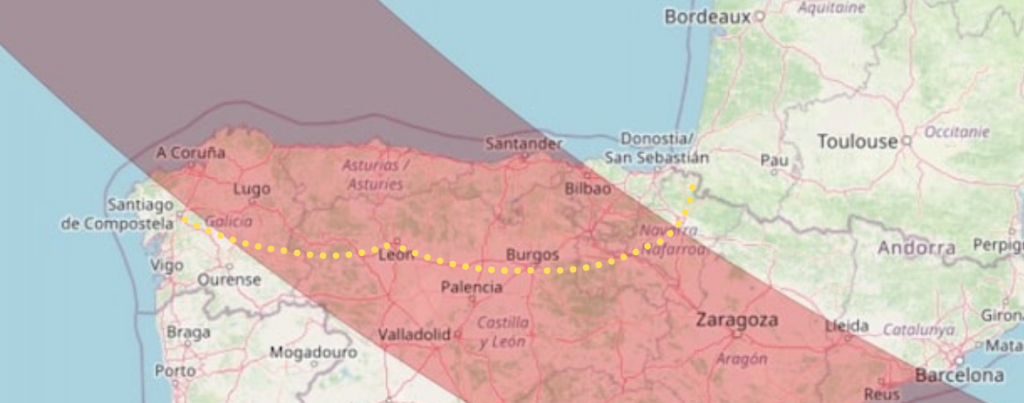
2026 Eclipse Path
The total solar eclipse will be visible along the whole Camino de Santiago in Spain.
What are we doing for the event?
We have programmed two tours for this event, a guided tour and a self-guided tour for pilgrims who appreciate a bit more independence.
Find out more in the links below:
Eclipse Self-Guided tour: August 8 – 15, 2026 (scroll to find the date).
Eclipse Guided Tour: August 4 – 14, 2026
And stay tuned for more information about the total solar eclipse on the Camino and Fresco Tours!
Click here for more information about the 2026 solar eclipse in Spain.
What is a solar eclipse?
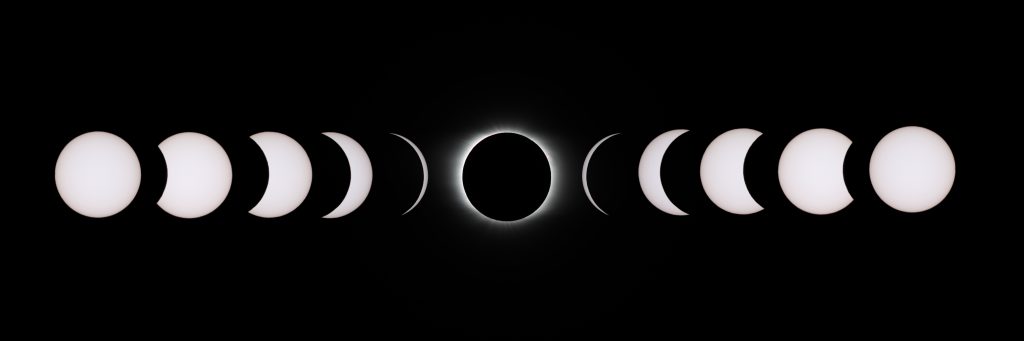
A solar eclipse happens when the Moon passes between the Sun and Earth, casting a shadow on Earth that either fully or partially blocks the Sun’s light in some areas. This only happens occasionally, because the Moon doesn’t orbit in the exact same plane as the Sun and Earth do.
A total solar eclipse happens when the Moon passes between the Sun and Earth, completely blocking the face of the Sun. People located in the center of the Moon’s shadow when it hits Earth will experience a total eclipse. The sky will darken, as if it were dawn or dusk.
Nasa Science
Spain Eclipse 2026
Unqiue Timing & Visual
Because this event happens late in the day (roughly 8:26 PM to 8:33 PM local time), the sun will be extremely low in the sky—less than 10 degrees above the horizon in the north, and barely 2 degrees above the horizon in the Balearic Islands.
- The Visual: You will see the eclipsed sun hanging low, likely distorted into a flattened oval by the atmosphere, potentially framed by landscapes or seascapes.
- The Atmospheric Effect: As the shadow rushes in, it won’t just get dark; the entire western horizon will turn unusual colors, often deep indigos and oranges, unique to low-altitude eclipses.
Tips and Recomendations
How to observe an eclipse safely?
Your safety is the absolute priority when watching an eclipse. You must never look directly at the sun without proper eye protection, even for a second. This rule applies during partial eclipses, annular eclipses, and the partial phases of a total eclipse. Ignoring this precaution can lead to serious, permanent eye damage.
What protection do I need?
Regular sunglasses, no matter how dark, are not safe for viewing the sun. You need specialized “eclipse glasses” or handheld solar viewers that comply with the ISO 12312-2 international safety standard. Ensure your glasses are from a reputable supplier and inspect them for scratches or pinholes before the event; if they are damaged, do not use them.
How do I plan my trip if I want to see the eclipses?
Start by identifying the “path of totality”—the specific narrow band on the map where the sun will be completely blocked. Once you know where the path is, decide on a region that appeals to you (e.g., the coast versus the mountains) and map out your travel logistics early. Transportation options may be limited closer to the date due to high demand.
Where is the best place to observe the eclipse?
Because the sun is so low, this eclipse presents a unique challenge: You need a clear view of the Western horizon.
Avoid Valleys: If you are in a deep valley or a city with tall buildings to your west, the sun might set behind a mountain/building before the eclipse becomes total. You need high ground or a flat horizon (like the sea).
Weather Strategy: The Coast (Galicia/Asturias/Cantabria): Riskier weather. These areas are prone to Atlantic fog and clouds.
The Interior (Castile and León/Aragón): Best bet for clear skies. The high, dry plateaus near Burgos, Palencia, or Zaragoza statistically offer the highest chance of a cloud-free view.
The Mediterranean (Mallorca/Ibiza): Great weather, but the sun will be dangerously low (only ~2° up). You strictly need an unobstructed view of the sea horizon.
More Information about Eclipses and Dates
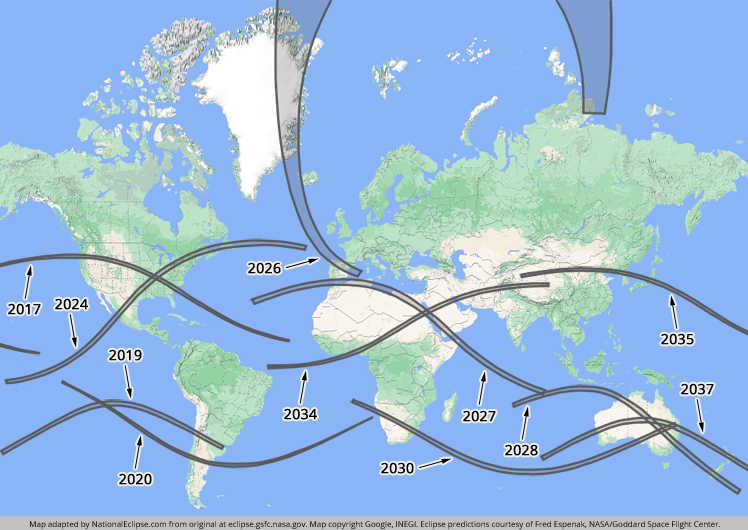
If you’d like more information about eclipses and upcoming eclipse dates and locations, the National Eclipse website is a good place to start: https://nationaleclipse.com/