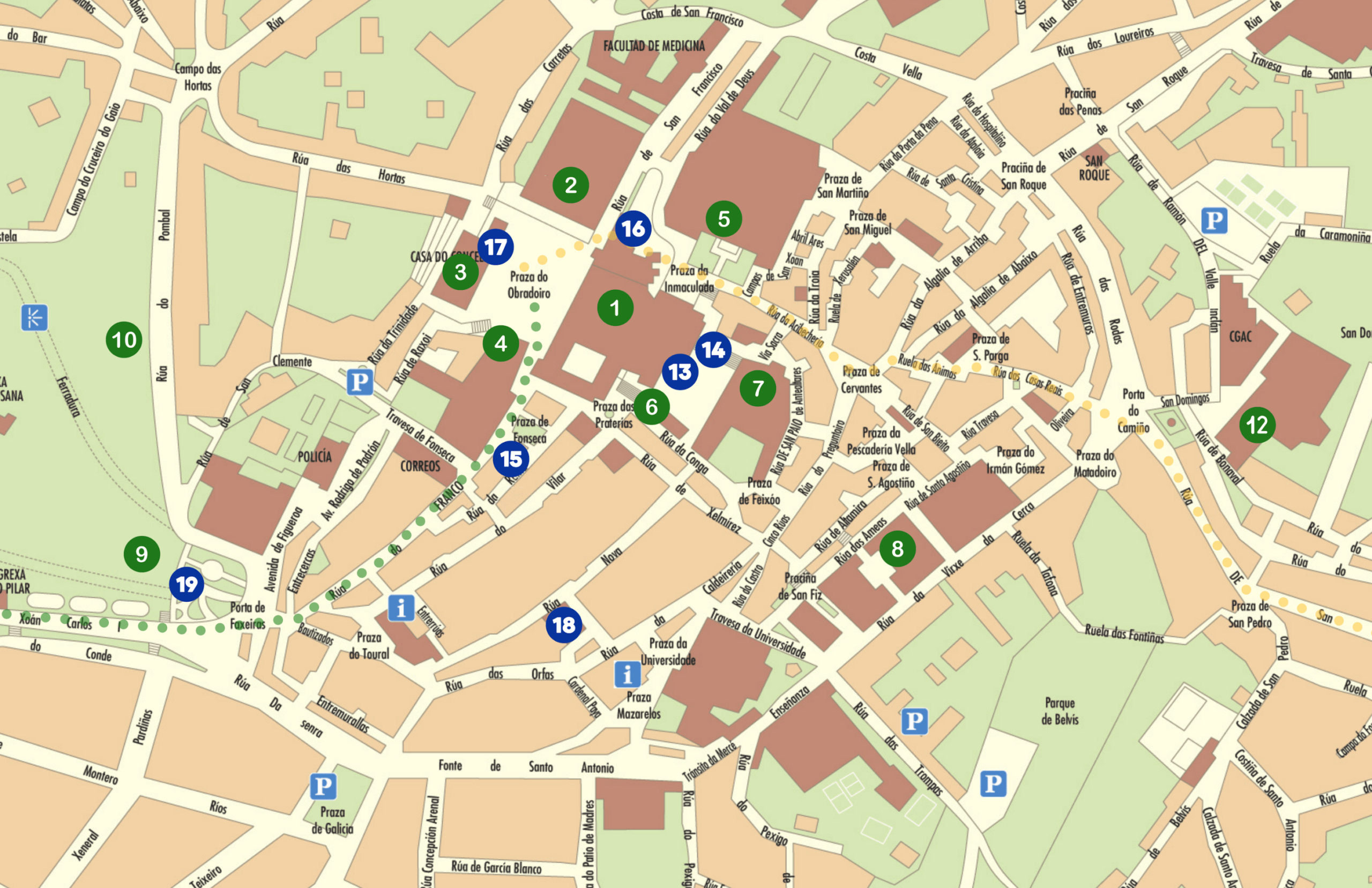
Here is a map of the must see sights in Santiago de Compostela. We have also featured some selected unusual sights in town. You can click on the image to enlarge it.

Main & Unusual Sights
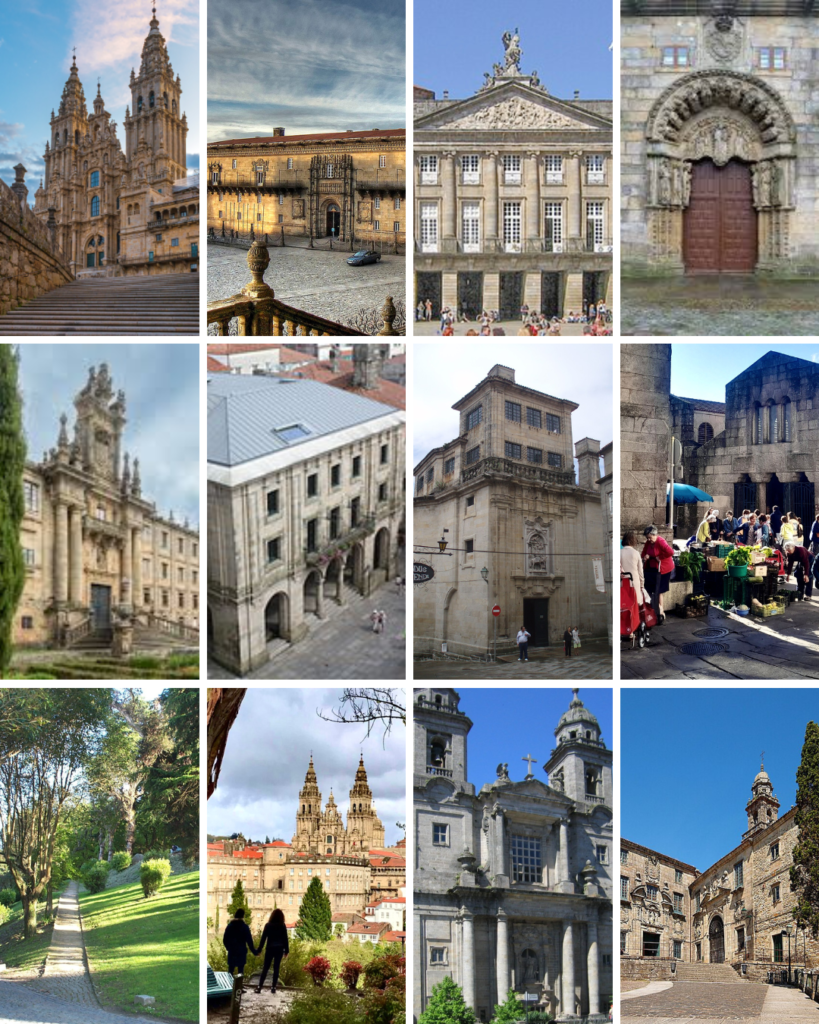
Main Sights in Santiago de Compostela
1. Santiago de Compostela Cathedral
The entrance to the cathedral is in the Praza de Praterías square. Tickets for the Pórtico de la Gloria, Cloisters and Cathedral Museum can be purchased in the ticket office on Praza do Obradoiro square. This is the end of the Camino de Santiago pilgrimage.
2. Hostal dos Reis Católicos
This building was once a shelter for pilgrims, it’s now a swanky hotel! The Hostal de los Reyes Católicos sits right by Santiago’s cathedral, mixing history with luxury. Think stunning courtyards, cozy corners, and top-notch service. Even if you’re not staying here, pop inside for a coffee with views of the cathedral.
3. Pazo de Raxoi
The Pazo is now the Town Hall and right across from Santiago’s cathedral. The 17th century building is a grandiosity, history and serious charm, all in one. Once you get tired of the cathedral, the Pazo provides a killer backdrop for photos and selfies.
4. Colexio de San Xerome
The medieval school is now the University of Santiago de Compostela Vice-Chancellor’s Office. This is the last of the monumental buildings that frame the Praza do Obradoiro square and a hidden gem with medieval feels. Once a school for poor students, its stone carvings and old-world charm make it a must-see stop. It may be small, but this quiet piece of Santiago’s past is full of history. Bonus points if you can spot the statue of Santiago (Saint James) on the door.
5. Monastery of San Martín Pinario
Originally built for Benedictine monks, it’s packed with stunning baroque details, a quaint cloister, and an ornate church. The building also houses a hotel and hostal for pilgrims, giving it a wonderful Camino vibe.
6. Museo de las Peregrinaciones
The Museum of Pilgrimage is a wonderful walk through the story of pilgrimages around the world and the Camino de Santiago. If you’re into the journey’s deeper meaning, this spot is definitely worth a visit.
7. Monastery of San Paio de Antealtares
The monastery sits behind Santiago’s cathedral, a peaceful retreat with deep roots in history. Originally built for monks, it later became a convent for nuns. It’s got a beautiful cloister, church, a small museum, and homemade almond cake and other pastries baked by the nuns inside!
8. Abastos Market
This market is the local fresh produce market for Santiago city center. It is alos Santiago’s foodie paradise! Bustling with locals, it’s the best spot for fresh seafood, Galician cheeses, and tasty tapas. Even if you’re not grabbing a snack, a visit to this colorful spot is well worth your time.
9. Alameda Park
This is Santiago’s go-to green escape packaged with a quaint little medieval church, perfect for a relaxing stroll and for some quiet from the town’s bustle. Grab a bench, breathe in the fresh air and start planning your next Camino.
10. View of the Cathedral from the Alameda Park
Want the perfect view of the cathedral looming over Santiago? This is the place.
11. Church of San Francisco
The first church is believed to have been built by Saint Francis of Assisi himself! The current and impressive Baroque building now houses a church, monastery and a hotel.
12. Museo do Pobo Gallego
The Museum of the Galician People is housed in a former convent, this monumental building now serves as a pantheon for illustrious Galician people. Rosalía de Castro fans will find her tomb here. Behind the museum is the charming Santo Domingo de Bonaval Park.
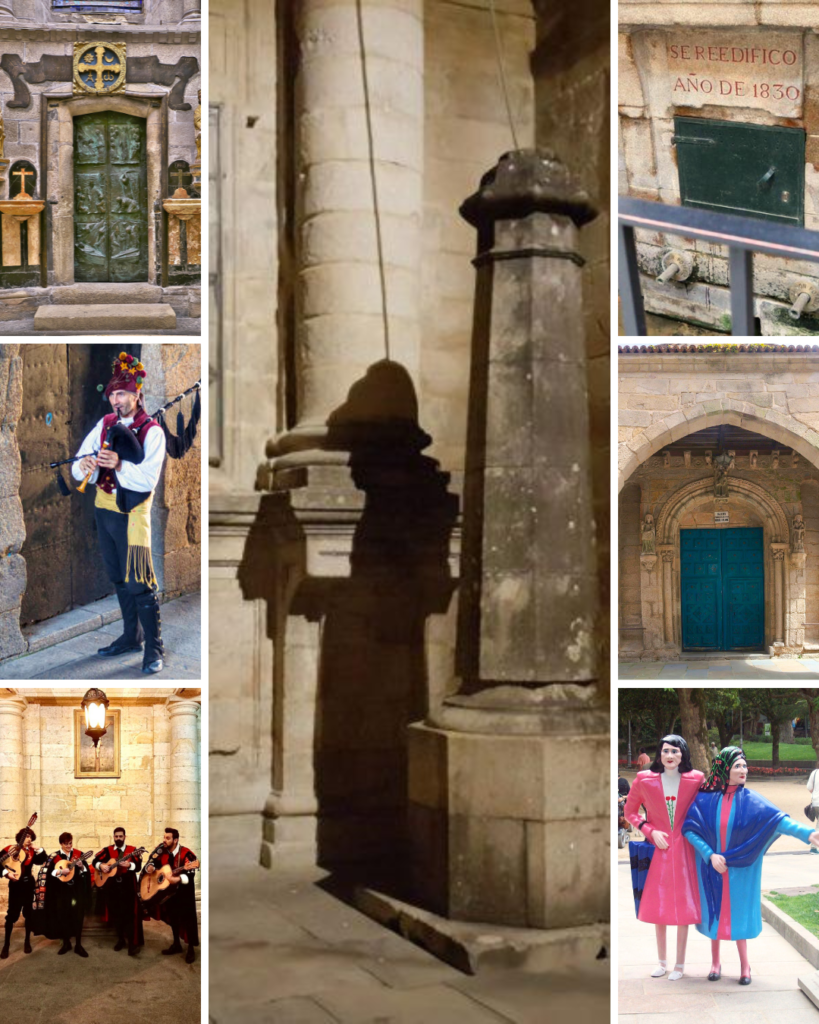
Unusual Sights in Santiago de Compostela
13. The Ghost of a Pilgrim
Every night a ghost can be seen in this corner of the Praza Quintana square behind the cathedral. But don’t worry, there’s nothing supernatural to be afraid of, the ghost is simply a play of shadows on the cathedral wall!
The story, because there’s always a story:
Legend has it that a priest fell in love with a nun from the next door convent of San Paio. Each night, he would hide in a secret passage beneath the Praza de Quintana stairs, the hidden link between the convent and the cathedral, where they would meet in secrecy. One night, weary of deception and longing for freedom, he begged her to run away with him. She agreed, and they promised to meet in the square the following night. Disguised as a pilgrim, he waited in the shadows, his face concealed, his heart filled with hope. But she never came. From that fateful night onward, lost in love and longing, he returns—forever waiting in anguish for the love that never was.
14. The Holy Door
Cathedrals and churches do not usually have a an entrance on the west, which would always be behind the altar. However, the Holy Door, or Puerta Santa in Spanish, to the cathedral is found here, in the Praza de Quintana, on the west side of the cathedral. But before you check it off your bucket list, bear in mind that the magnificent 16th century entrance you are admiring is not actually the Holy Door, but the outside entrance to the Holy Door. The actual Holy Door is the bronze one inside, which you may be able to glimpse. This door is sealed shut witha brick wall until the next Holy Year. At the beginning of a Holy Year, the door is reopened by the Archbishop with a solemn ceremony that involves breaking down the brick wall.
A Holy Year is when the Feast of Santiago, July 25th, falls on a Sunday.
15. Fuente del Franco
No, not ‘that Franco’. In Galician language, franco means Frenchman, hence de name of the street you are on. But why is this overlooked and no-longer-in-use fountain a sight?
Tradition says that the two oxen that were transporting Santiago’s remains from Padrón to his burial site got thirsty, stopped to drink from a spring that was here, and in this manner indicated to Santiago’s disciples the location for his burial. The cathedral is indeed very close by.
16. The Bagpipe Busker
He or she have become a sight in their own right because they are always here with their pipes, under the archway. I if I knew how to play, I would too, considering the steady influx of pilgrims that pass by every day. In any case, it’s a special experience for thousands of pilgrims to have their last steps on the Camino accompanied by Celtic pipe tunes.
17. La Tuna
Like the Bagpipe Busker, La Tuna are usually in this spot every evening and have become a sight in the city. La Tuna in Spain is a distinctive tradition that intertwines culture and music, originating in medieval Spanish universities. These musical groups are formed by university students and friends. The members always don traditional, Renaissance-style garb and perform a repertoire of folkloric songs.
18. Church of Santa María Salomé
This 18th century church is often overlooked by visitors to the city. However, what makes it stand out is that it is the only church that we know of that is dedicated to the mother of Saint James the Greater: Saint Mary Salome. Although this is not actually stated in the Gospels, tradition believes that James the Greater was John the Evagelist’s brother (both were apostles), and that their mother was Mary Salome.
19. Statue of the Las dos Marías
The gaudy life-sized statue is found in the entrance to the Alameda Park. And unless you know the story, you most likely would walk by a bit perplexed.
The story
Las dos Marías (the two Marys) were Maruxa and Coralia, two of thirteen siblings from a working-class family in Santiago de Compostela. During the Spanish Civil War (1936-1939), their family suffered repression because of their leftist political views. Their brothers were imprisoned, tortured, or forced into exile, and the sisters themselves endured persecution and social rejection for most of their lives. Despite their situation, Las dos Marías eventually became famous for their flamboyant and unconventional behaviour. Every day, precisely at 2 PM, they would walk through the Alameda Park, dressed in bright, eccentric clothing and heavy makeup. They flirted with young university students and made risqué remarks — defying societal expectations for women. Thus, their public presence was understood as an act of resilience.
Though they were often mocked, they were also admired by the locals as symbols of defiance, freedom, and individuality. Today, their memory lives on in through the statue in the Alameda Park, depicting them as they once were — defiant, dressed in bright colours, and full of life.