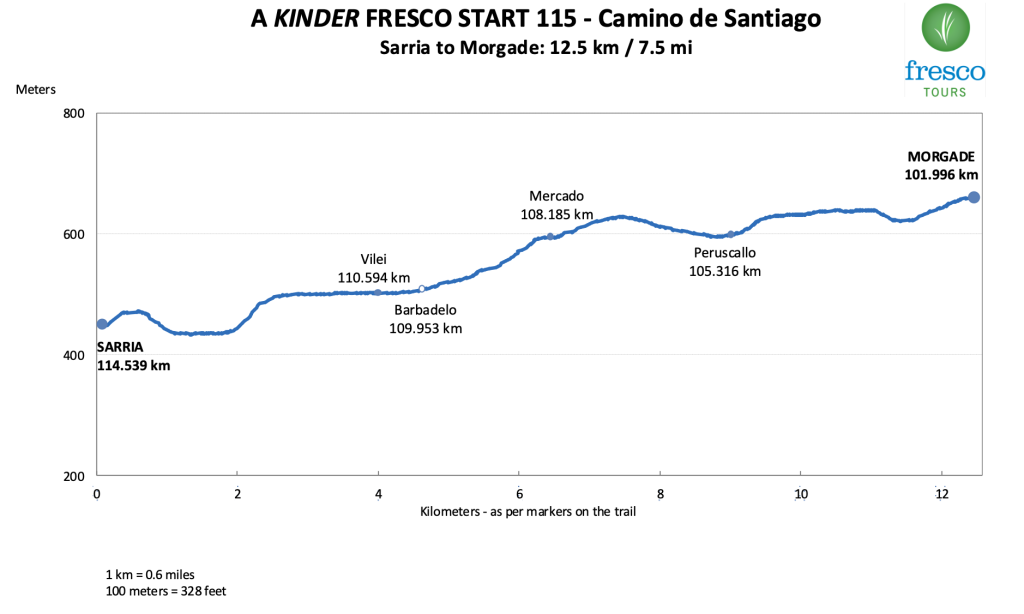
Today you walk from Sarria to Morgade, in the historic Paradela district. Sarria is named after the river that flows through it, the River Sarria. There is a fairly accepted hypothesis that the origin of the river’s name (and thus the town’s) comes from a Pre-Roman Gaelic tribe that had settled in this region, the Seurri.
Sarria is also the unofficial starting point for pilgrims who only can or want to do the required last 100 kilometres. Indeed, only a few hours on our way, we will pass by the 100 km marker to Santiago de Compostela.

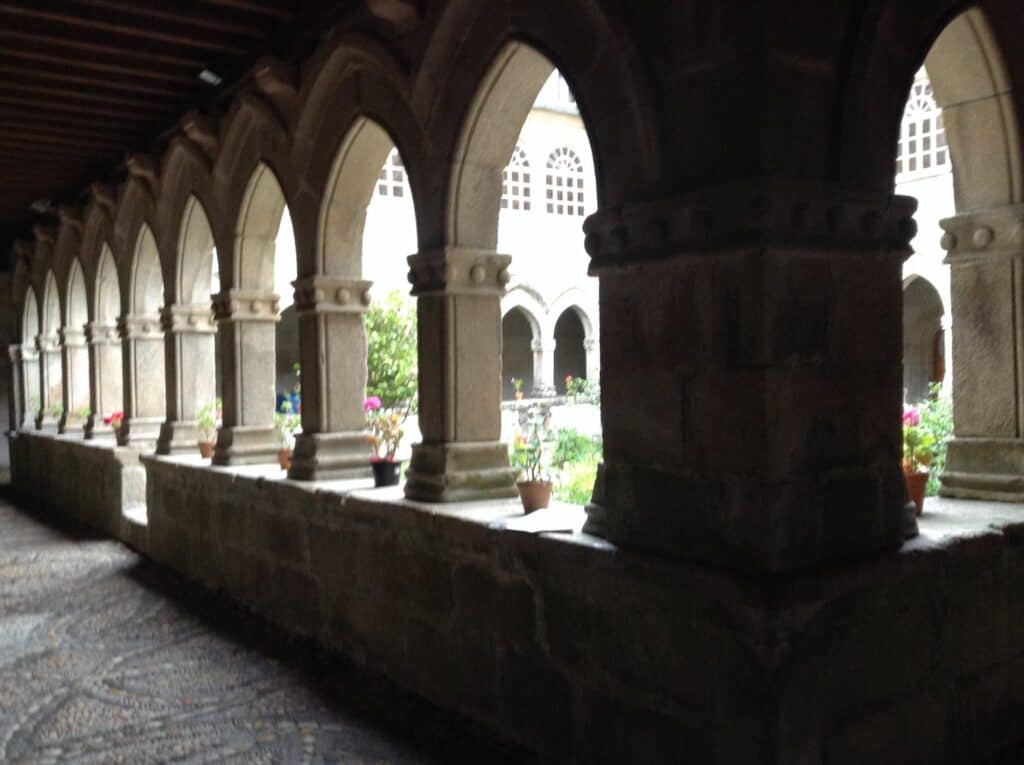
Perhaps Sarria’s best-known monument is the Mercedarian monastery of the Magdalena (Magdalene). It is right at the top of the hill and you can visit it (assuming it is open) just before initiating the descent out of town. It is a Gothic structure that boasts a lovely cloister. The convent also offers a basic but appropriate pilgrim’s hostel. Note the interesting sculptures in relief by the main door, which depicts the arrival of Mary Magdalene (hence the name of the convent) by boat to the city of Marseille where she preached and lived until her death.
The Mercedarians (aka. Order of the Blessed Virgin Mary of Mercy)
This religious order was founded in the early 13th century by Saint Peter Nolasco after receiving instructions from the Virgin Mary. Its main mission, apart from monastic duties to God, was to pay the ransoms of captured Christians.
The ransoming of captives and the slave trade of captured Christians was a prosperous business during the Middle Ages (moreover for the Muslim side as they traded in slaves). Thus, pirate pillaging and plundering was a common occurrence throughout these times, especially in regions that were under Christian control. St. Peter Nolasco, concerned about the plight of these Christian captives, set up a network of monasteries throughout Europe that gradually became very successful thanks to popular, noble and royal patronage. The order is supposed to have freed up to 70,000 captives, of which 2,700 were freed during the saint’s time.
Apart from the three classic monastic vows (obedience, conversion of life, and stability), the Mercedarians take a fourth vow, which is to give their life for someone who is in danger of losing his or her faith.
Barbadelo
The church of Santiago of Barbadelo is one of the artistic highlights on the Camino in Galicia. The main reason for this is that it is one of the few that actually dates back 800 years with most of its parts intact and that it has not been reconstructed. The other reason is the eerie figure that graces its tympanum.
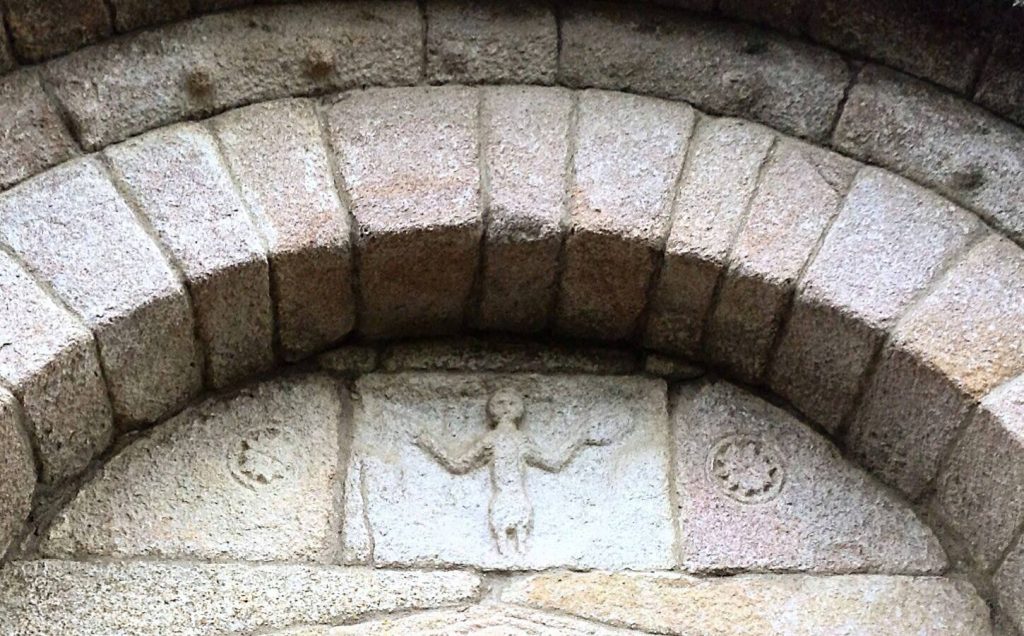
Make sure you do not walk by the church without having a peek inside (or outside). The church is not on the Camino and you will have to make a short detour of about 50 metres to visit it. It is to your left and there are large signs with tourist information. The church is always open and is staffed to welcome pilgrims.
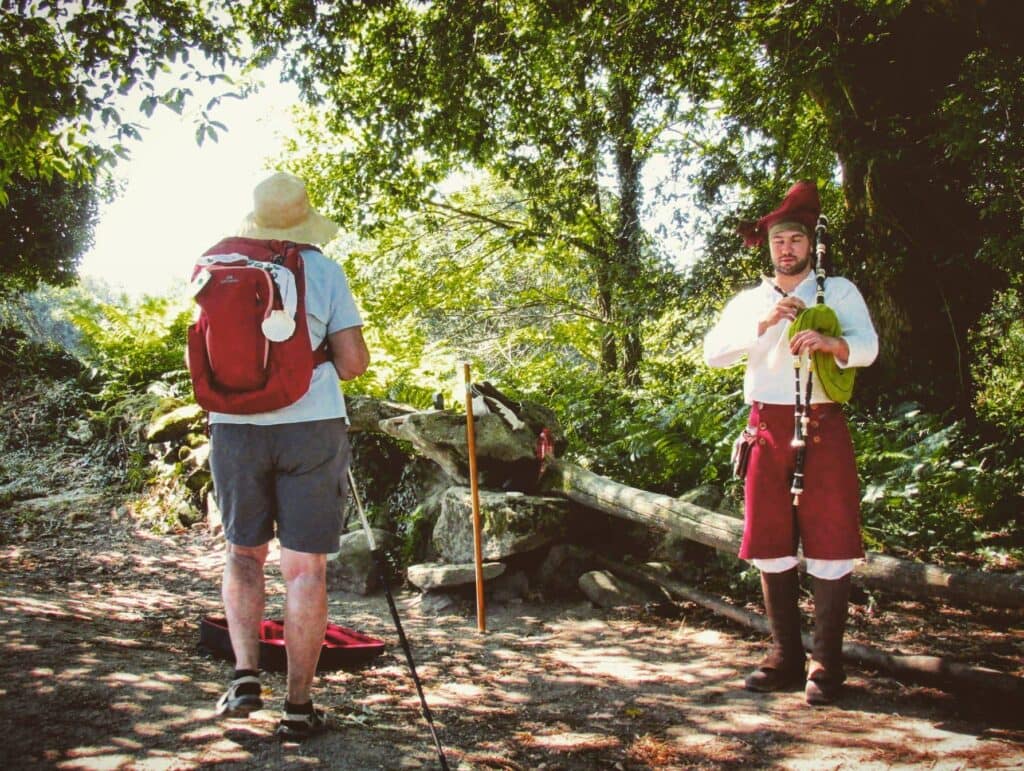
Your destination today is the hamlet of Morgade, which is a lovely location and a popular pilgrim pit stop thanks to its inviting café, and because it is the first real lunch opportunity you have after leaving Sarria.